Exploring for gold in the historic Serranía de San Lucas district.
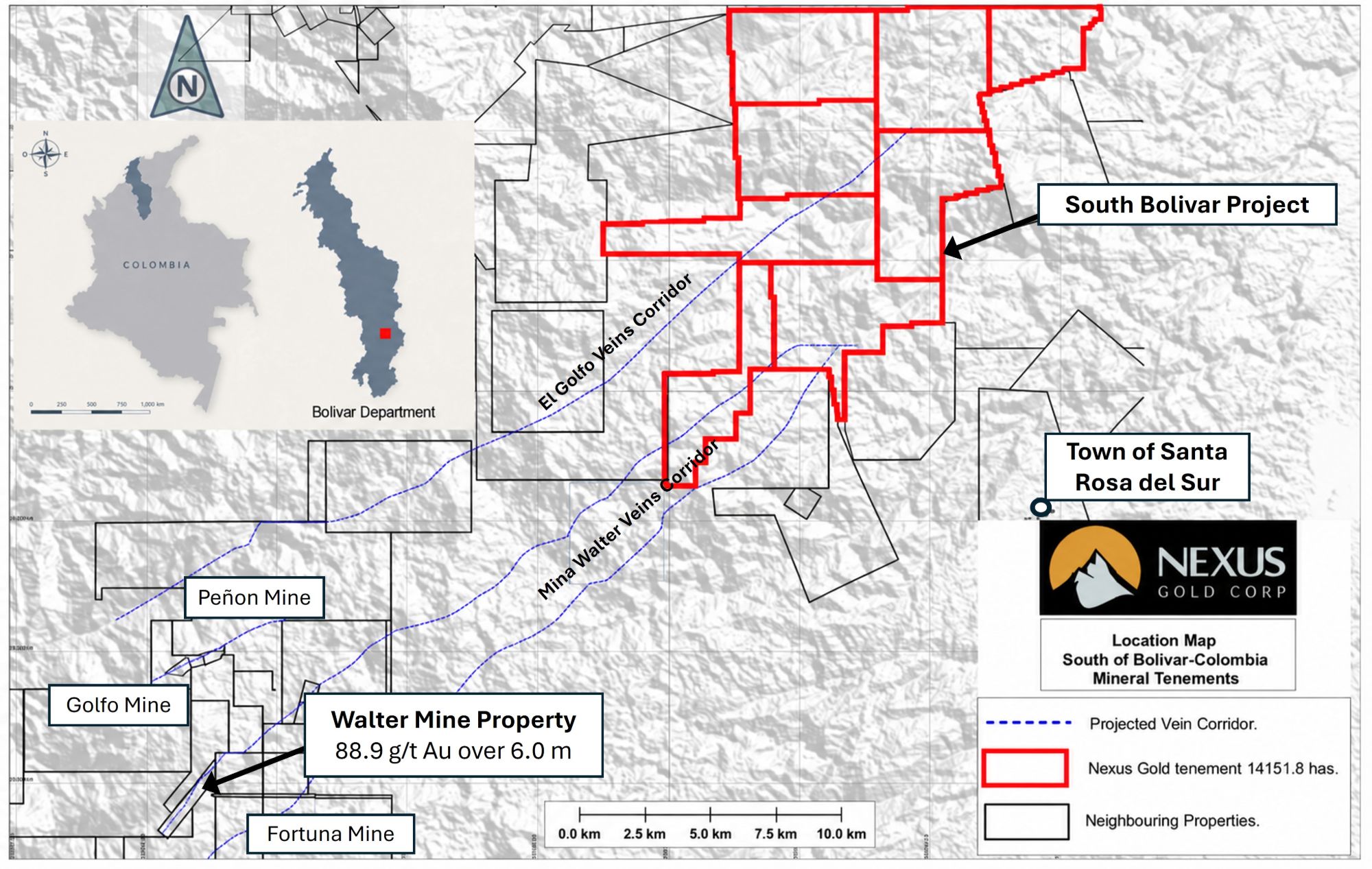
Nexus Gold’s South Bolivar Project comprises eight mineral concession applications covering approximately 14,151 hectares (141.5 km²) in Colombia’s South Bolívar gold district. Located approximately 8 kilometres northwest of Santa Rosa del Sur, the application areas lie within the historic Serranía de San Lucas gold region. The applications support Nexus’s strategy of combining exploration of prospective Colombian ground with evaluation of advanced gold projects offering a potential pathway to production.
The opportunity is to apply geological mapping, geochemistry and targeted geophysics to ground where historical artisanal workings and regional structures provide a starting point for exploration. Nexus intends to assess these features systematically and develop targets for potential drilling, subject to the granting of the applications and receipt of applicable permits and approvals.
Highlights
- Eight mineral concession applications covering approximately 14,151 hectares in southern Bolívar, Colombia.
- Interpreted structures within the application area share characteristics with structures associated with known gold mineralization elsewhere in the district.
- No evidence of historical drilling has been identified within the Company’s application areas.
- The Walter Mine, approximately 20 kilometres southwest of the nearest application boundary, provides a regional geological analogue for the targeted mesothermal gold systems. Historical sampling at the Walter Mine reportedly returned values including 88.9 grams per tonne (“g/t”) gold (“Au”) over 6.0 metres (“m”). These results have not been independently verified and are not necessarily indicative of mineralization within Nexus’s application areas.
- Nexus is establishing its Colombian exploration position at a time when the country’s new national government has signalled support for renewed natural-resource investment, exploration, mine development and more efficient permitting.
Regional setting and exploration potential
The South Bolívar gold district occupies part of the Serranía de San Lucas at the northern end of Colombia’s Central Cordillera. Gold occurs in both vein systems and alluvial deposits, and artisanal and small-scale mining has been an important part of the region’s history.
The district’s mining history demonstrates the presence of gold-bearing systems, while modern systematic exploration has been comparatively limited, partly due to difficult access and dense vegetation. Nexus intends to build on regional geological interpretations and historical artisanal workings through a staged exploration program.
Geology and mineralization
Regional geology includes Jurassic intrusive, volcanic and sedimentary rocks. Diorites and granodiorites associated with the Norosí Batholith host gold mineralization in parts of the district, with north- and northeast-trending faults and shear zones providing important structural controls.
Nexus’s principal exploration model is shear-zone-hosted mesothermal gold mineralization. These systems can comprise steeply dipping veins and mineralized structures with gold associated with quartz, sulphides and altered wall rock. Historical descriptions from the Mina Walter Property identify pyrite with lesser chalcopyrite, galena and sphalerite, accompanied by quartz, carbonate, clay and chlorite alteration.
Current regional interpretations indicate that similar structural features occur within the South Bolivar Project. Initial fieldwork would test those interpretations, establish the local geology and determine which structures warrant follow-up sampling. The presence of comparable regional geology does not establish the presence, grade or continuity of mineralization on Nexus’s ground.
A starting point for systematic exploration
Historical artisanal workings identified within the application areas provide locations where exposed structures and altered rocks can be mapped and sampled. These workings may help establish the orientation of veins, the distribution of sulphides and alteration, and the relationship between mineralization and regional structures.
Systematic coverage beyond known workings will also be important. Integrating mapping and geochemical results with regional geological information can help identify additional targets beneath vegetation or in areas where previous activity was concentrated only on visible surface occurrences.
Proposed Exploration Strategy
Subject to the successful granting of the applications and receipt of applicable permits and approvals, Nexus intends to advance its South Bolívar position through a staged exploration program.
Initial work is expected to include:
- Compilation and interpretation of regional geological, structural and historical mining information;
- Detailed geological and structural mapping;
- Mapping and sampling of historical artisanal workings and exposed vein systems;
- Systematic rock and soil geochemistry;
- Identification and prioritization of structural targets;
- Geophysical surveys where appropriate; and
- Development of priority targets for potential diamond drilling.
The objective is to identify and prioritize exploration targets across the application areas.
Walter Mine: Regional Exploration Analogue
Historical technical information describes Walter as a shear-zone-hosted mesothermal gold system developed within diorites and granodiorites associated with the Jurassic Norosí Batholith. The principal Walter structure has been described historically as a northeast-trending, steeply southwest-dipping shear and vein system approximately 2.5 metres to more than 5 metres wide.
Mineralization is reported to consist predominantly of pyrite, with lesser chalcopyrite, galena and sphalerite, accompanied by quartz, carbonate, clay and chlorite alteration. Historical underground work reportedly demonstrated continuity of the Walter structure for at least one kilometre along strike and 130 metres vertically; additional mineralized occurrences were reported northeast of Walter.
Historical sampling at the Walter Mine reportedly returned significant gold values from mineralized vein exposures. Available descriptions suggest a combination of grab, chip and channel samples, rather than diamond drill intersections; the sampling method for each reported interval has not been independently established.
Reported historical gold values include:
| 147.5 g/t Au) over 1.0 m | 41.4 g/t Au over 1.25 m | 55.9 g/t Au over 3.0 m |
| 95.0 g/t Au over 1.6 m | 20.8 g/t Au over 2.0 m | 73.5 g/t Au over 2.0 m |
| 69.3 g/t Au over 1.5 m | 88.9 g/t Au over 6.0 m | 17.7 g/t Au over 4.3 m |
Although the Nexus applications lie northeast of Walter, the Company is not asserting that the Walter structure extends onto its application areas. Walter is a regional geological analogue only. Walter is a third-party property in which Nexus has no interest. Its historical results are not necessarily indicative of mineralization on the Nexus applications, where comparable grade, width or continuity has not been established.